


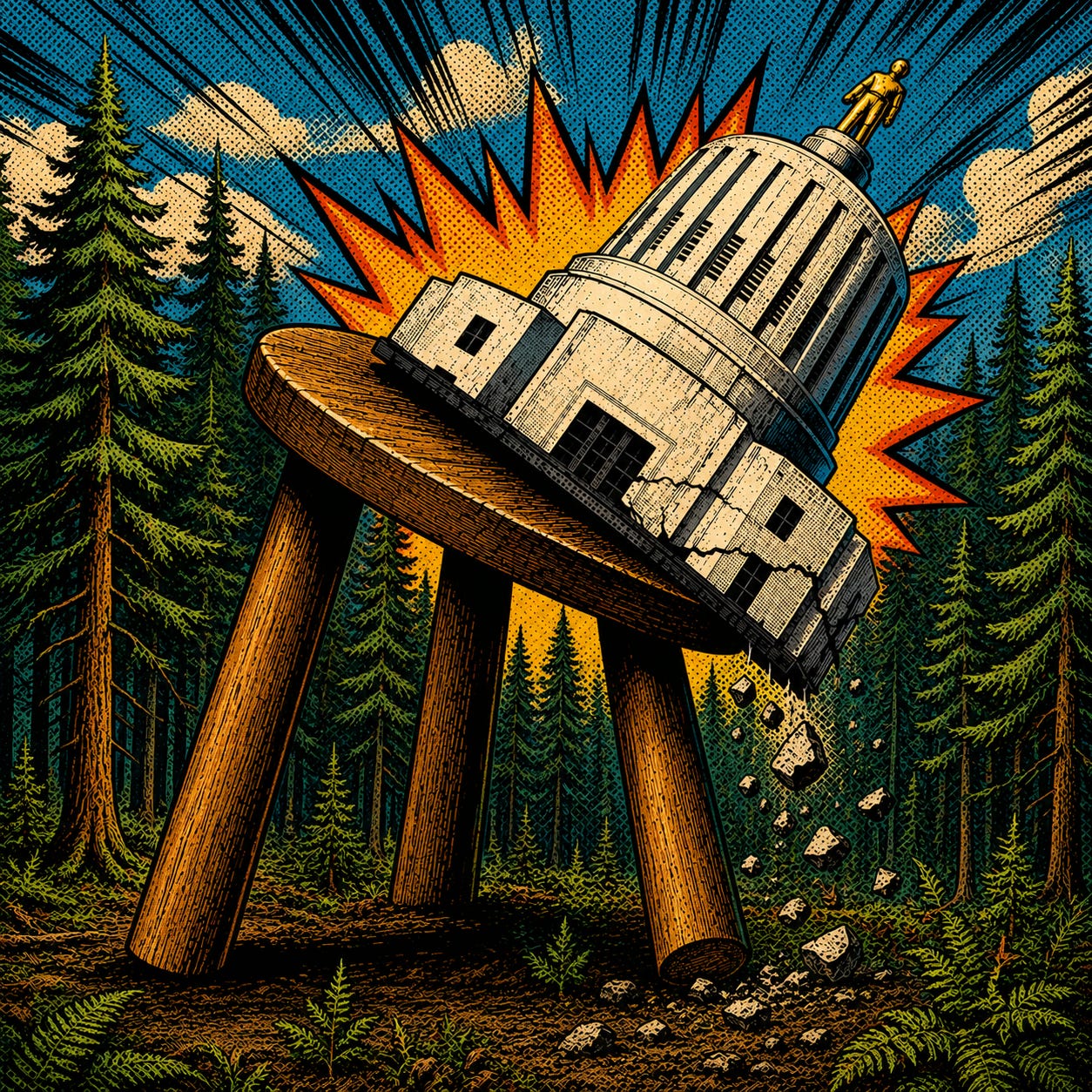
The Three-legged Stool of Sustainability
I’m a forester, not a policy expert, but my work is shaped by policy decisions made far from the forest. I oversee management of the Hampton family’s timberland in Oregon and Washington and make sure our mills have enough timber to keep the lights on and people working. I started my career with the Oregon Department of Forestry and have a lot of respect for state forest managers and their mission. Lately, I’ve been watching state forest agencies in both states make major policy shifts that reduce timber harvest on state lands. Timber sales are being paused or scaled back, and large areas are being taken out of production. However well-intentioned those decisions may be, they come with consequences and not just for industries like mine. Among other impacts, the decisions result in less revenue to pay for forest management.
In both Washington and Oregon, state forest agencies are facing real budget pressure. As timber sales are reduced or paused, the money that pays for day-to-day forest management shrinks with it.
Washington: Taking Land Out of Production Without a Clear Plan
Washington’s Department of Natural Resources (DNR) manages around two million acres of trust land that by law is supposed to generate timber revenue for schools, counties, and local services. However, DNR is taking some of that land out of production without a clear plan for how to compensate trust beneficiaries or replace lost revenues from those harvests. The Commissioner of Public Lands recently moved 77,000 acres of state forestland out of active timber production and paused a number of timber sales in older (but far from being old growth) forests. The stated goal is to create more structurally complex forests for habitat and carbon storage. Many environmental advocates have been pushing for this for years. Old growth forests have ecological value, but I don’t believe removing these younger stands from production serves the broader public interest for which these lands were set aside.
What often gets overlooked in the conversation is that the state’s Habitat Conservation Plan already ensures large areas of this forestland is managed primarily for habitat. The question is whether taking additional acres out of production delivers enough ecological benefit to justify the financial consequences for trust beneficiaries and local communities. Timber harvest is how the trust land system has worked for decades. It’s a system that would continue to provide revenue (and growing forests) in perpetuity. When large areas are removed from the harvest base, that revenue disappears immediately and for good.
I’ve heard some Washington leaders suggest that carbon markets and ecosystem services could fill these funding gaps. Those ideas might pencil out someday, but right now, they’re not reliable income streams and at current prices, they provide a fraction of the value timber harvesting does. They also do not address losses in local logging, hauling, and milling jobs that would occur under such payment schemes.
I think pausing timber sales and shrinking the harvest base without secure replacement funding is reckless. It puts counties and schools in a bind and shifts financial risk onto communities that don’t have many other options.
Oregon: The Accountability Gap
Oregon is facing similar problem. The Western Oregon State Forest Habitat Conservation Plan (HCP) was designed to reduce legal risk under the Endangered Species Act and provide long-term certainty for species protection. It provides that and sets aside 50 percent of the forest for habitat. But such expansive environmental protections come at a significant cost.
The 70-year HCP significantly reduces projected harvest levels on state forestlands—lands that are supposed to pay for their own management and support rural counties through timber revenue—to the tune of $2.2 billion over the life of the plan. County leaders have raised concerns for years that harvest targets keep dropping without a clear backstop. These counties certainly have budget holes to fill now, but so do state forest managers who rely on harvest revenue to pay staff to manage these lands, provide recreational opportunities, and fight fires. So far, there’s been no clear accountability for the financial situation the agency finds itself in. Some might hope that the General Fund will step in if revenues fall short. But those General Fund dollars are not sitting idle waiting for another use. They already support essential services—especially K–12 education—so replacing lost timber revenue means shifting costs elsewhere, leaving taxpayers to fill the gap, or accepting cuts to other public priorities.
Relying on future legislatures to fix a structural funding problem is a gamble. We’ve seen this story play out before. When federal timber revenue dried up in the 1980s, Congress sent payments to counties and schools to try to compensate them for the lost economic activity. They were paid a fraction of what they once received from timber activity and since Congress failed to reauthorize the program in 2024, they receive nothing.
The Environmental Perspective and the Missing Tradeoffs
The environmental advocates that have pushed for these additional set-asides are clear about their goals: more habitat and more older forests. What’s too often missing from the conversation is an honest accounting of the tradeoffs.
State forests aren’t parks. They were set up to produce multiple environmental, social, and economic benefits. When agencies voluntarily reduce harvest without replacing the revenue, they don’t eliminate costs, they just shift them.
Why This Matters to All of Us
Declining harvests could certainly mean fewer logs for mills like ours. But from my perspective, the deeper issue is the long-term viability of state forests and the industries and communities they support. State forests were designed to fund their own management, and right now, the system seems to be at risk of breaking down.
If state forest agencies run out of money, the consequences won’t stay on paper. You’ll see fewer staff, less active management, more deferred work, and higher wildfire risk. And there will be more pressure to pull money from other public programs to cover forest management costs, competing with schools, healthcare, and public safety. I don’t think that’s a great win for conservation, and it’s certainly not fair to rural counties that want active and responsible stewardship of the forests that surround them.
I don’t mean to suggest that financial considerations are the only factor we should care about when developing forest policy. As a resident of a forest-dependent community and an outdoorsman, I personally place great weight in the social and environmental benefits of forests. Major changes to forest management should be grounded in science, informed by experience, and accompanied by an honest assessment of both the benefits and the costs. If we can’t afford to manage the forest systems we’ve created, I don’t think that’s a sustainable path.