


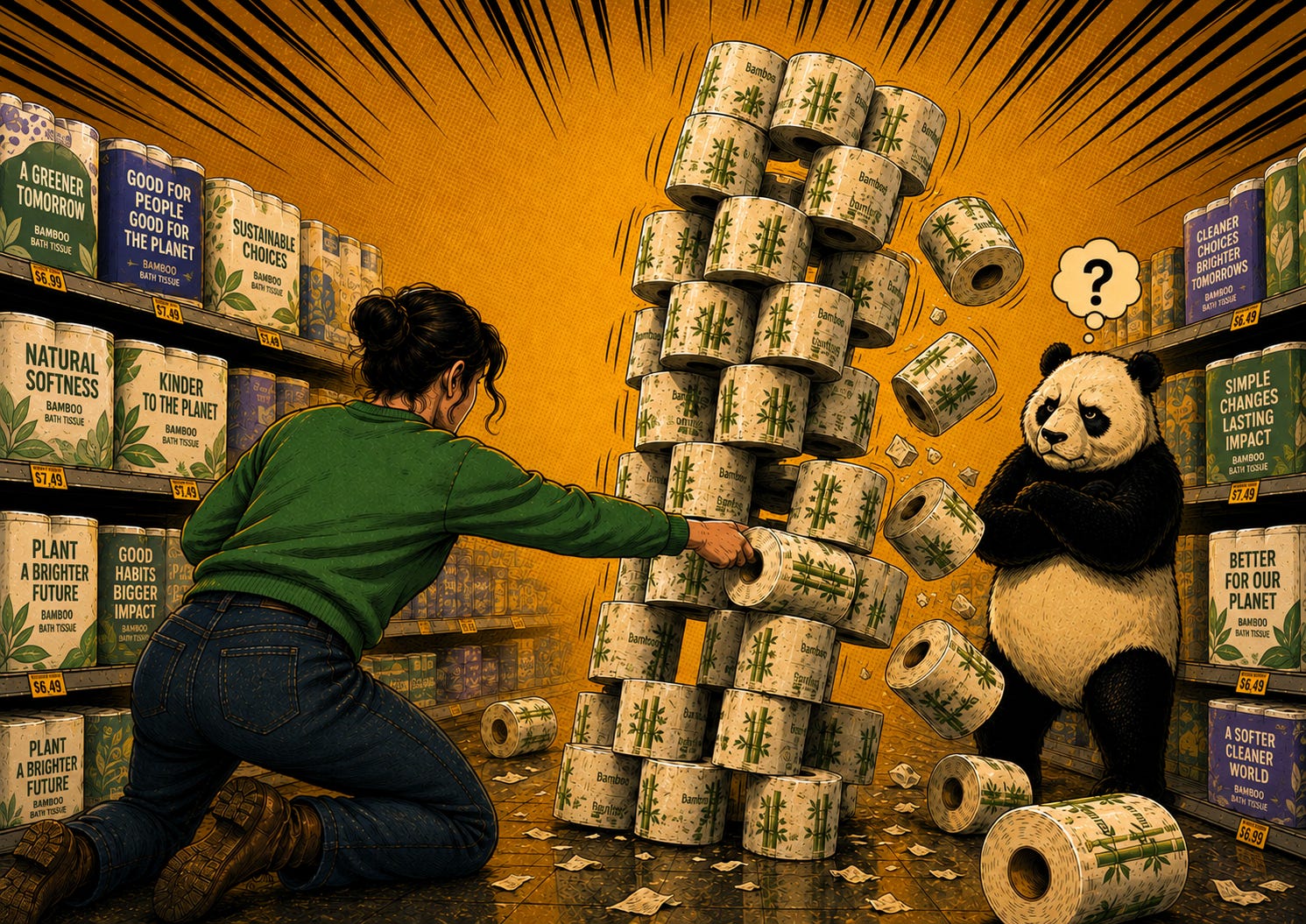
My favorite neighborhood market is one of those places where every product tells a story. The meats have biographies. The coffee has a mission statement. That’s part of why I like shopping there. I’m interested in where things come from and how they’re made.
Recently while shopping, I stumbled upon a towering display of bamboo toilet paper in the housewares section that practically radiated environmental virtue. Bamboo is better for the planet so skip the trees and save a forest. At least, that was the impression. But for shoppers in the Pacific Northwest, that story is a lot more complicated.
Let me first say, I don’t have an issue with bamboo as a material. It’s a remarkable plant that grows quickly and can be used in a myriad of ways from flooring to cutlery. Pandas like it so much they eat little else. Rather, my issue is with our tendency to evaluate sustainability through a single lens, even when it so often depends on context and the broad and complex systems that enable the products we use every day.
Many consumers understandably assume that choosing bamboo over tree-based products helps reduce forest harvesting. In the Pacific Northwest, that’s not really how the system works. Here, most harvesting is driven by demand for lumber and other building materials. When a log is turned into lumber, not every part of that log becomes a board. Over time, the industry has gotten pretty good at finding uses for the wood chips, shavings, and sawdust that remain. A report published by the USDA Forest Service in 2021 found that less than one-tenth of one percent of the residual material generated by Oregon sawmills and plywood plants goes unused. Most of that material—about 70 percent—goes to pulp, paper, and other reconstituted board products.
While wood fiber from Pacific Northwest sawmills fits into a larger system that puts nearly every part of the tree to use, bamboo toilet paper follows a very different supply chain. Many of the bamboo toilet paper brands sold in the U.S. source their bamboo from China, where much of the world’s commercial bamboo is grown. The finished product then has to make its way across an ocean to reach us. While that doesn’t automatically make the product an unsustainable option, it does mean the environmental equation is more complicated than “bamboo good, trees bad.”
From a resource-efficiency perspective, making paper products from sawmill residuals makes good sense. There are still a number of toilet paper producers in the Pacific Northwest. Georgia-Pacific’s Wauna mill near the Oregon coast, for example, uses fiber produced at our own Warrenton lumber mill.
And it’s worth remembering that unlike most agricultural lands, Pacific Northwest working forests provide much more than a crop. Harvesting a working forest obviously changes that forest, but harvest is not the same thing as permanent forest loss. In both Oregon and Washington, timber harvest is governed by state forest-practices laws designed to protect things like water quality, fish and wildlife habitat, and soils. Private timberland must be replanted after harvest, beginning another cycle of forest growth. During that cycle, the lands that produce timber also provide different types of wildlife habitat, watershed protection, recreation and other benefits.
For those of us who live in the Pacific Northwest, there’s also a local dimension to this story. Across the region, people take great pride in growing, harvesting, transporting, and manufacturing forest products. The supply chain behind an ordinary roll of toilet paper is probably not something most of us spend much time thinking about, but it’s more local than many might think.
All this is to say, in the grand scheme of complex sustainability debates, this might be one area where we can all relax a little.
Standing in that grocery store, I briefly considered explaining the environmental and economic benefits of residual wood fiber utilization to my cashier. Fortunately for him, and the line of people forming behind me, I thought better of it. Instead, I paid for my groceries, grabbed my bag (yes, paper, please), and headed home to find a more appropriate audience.
Thank you! I also wonder what the working conditions are in China on the bamboo tree farms. And does bamboo need irrigation? Herbicides?
Glad to hear I'm not the only one who has pondered this while waiting in line to buy groceries!